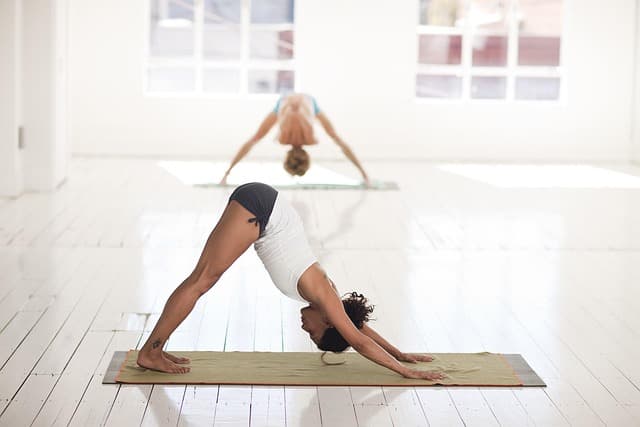
In different directions of yoga you can find different variations of the technique of performing Adho Mukha Shvanasana. In particular, in Iyengar yoga Downward-Facing Dog is performed from the initial position lying on the stomach. Also it can be performed from standing position. And in Surya Namaskar complex the initial position for it is the Horseman’s Pose.
We will consider the most suitable for beginners technique of performing the asana “Downward-facing dog” from the Cat Pose:
- Starting position: Marjariasana (knees under the hip joints, palms under the shoulder joints). The feet are on the toes. There is the same distance between the palms of the hands as between the feet. If the feet are placed at the width of the mat, this position will help to open the pelvis and sacrum.
- Open the fingers of the hands and root the palms of the hands firmly into the floor. Point your middle fingers strictly forward, and press the bases of your thumbs and index fingers against the floor.
- As you exhale, lift your pelvis up, bending your legs at the knees, pushing off the floor with your hands, with a straight back – the body takes the shape of a triangle. Pay attention to the fact that the back should not be rounded in either the lumbar or thoracic region while performing asana.
- If your hamstrings are tight, leave your legs bent at the knees. Slightly spread your heels apart, leaving them weighted, which frees up the sacrum area. Over time, through regular yoga practice, your hamstrings will gradually lengthen and you will be able to perform the full version of the asana, but initially take your time to avoid injury and overstretching of the muscles.
- Raise the sciatic tubercles up, which tilts the pelvis forward, and make as if you are trying to spread the feet apart, but the legs remain stationary, this tilts the sacrum forward (this movement is called “nutation of the sacrum”).
- If your hamstrings and Achilles tendons allow, while pushing your hips back, try to gradually straighten your legs and lower your heels to the mat. Keep in mind that as long as your heels remain in the air, Downward-Facing Dog will not be a resting pose for you – standing on your toes, the body is shifted forward, not backward, as it should be if your heels tend to sink to the floor.
- Knees should look strictly forward, kneecaps tightened, hips turned inward – this activates the quadriceps muscle of the thigh, relaxing the antagonists – the back surface of the thighs, thus contributing to their stretching, which allows you to straighten the legs.
- The arms should be straightened at the elbows. Elbows point to the sides (check that the elbow curves are in line with the thumbs), shoulders turned outwards, shoulder blades inwards.
- Check yourself if the asana is correct in terms of the position of the hands in the following way: try to take the little and ring fingers off the floor at the same time. If it is possible to do this and the axillae are pointing towards the floor, then the position of the hands is correct.
- Extend the neck away from the ears and relax the neck muscles. The head hangs down freely.
- The weight of the body should not go into the hands, but should be distributed evenly on the hands and feet. Root yourself in the four points of support (feet and hands). Pay attention to keeping your back straight. If you have good flexibility, there is a high probability that a strong flexion will occur. Therefore, retract your ribs to keep your back straight.
- Eyes can be covered.
- Exit the asana by bending your legs at the knees and return to the starting position of Marjariasana.