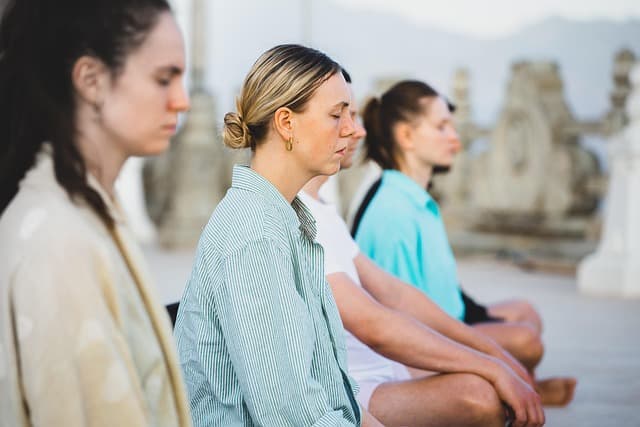
When getting acquainted with full yogic breathing, many people face difficulties, as they usually breathe unconsciously and are not used to control this process. The speed of inhalation and exhalation, their depth – all these are natural reflexes of the body, which in yogic breathing should be under full control.
How to prepare for practicing breathing:
- Ventilate the room you will be practicing in well, and make sure the temperature is comfortable.
- Try not to let external stimuli distract you.
- Postpone exercise if you are ill, anxious or stressed. The most important condition for successful training is internal comfort.
The main condition for full breathing is awareness. It is necessary to keep in attention every breathing cycle. Try to breathe freely, without excessive effort and without tensing muscles.
The first stage of preparation
During it, you need to perform a simple exercise that most people get without difficulty. Sit up straight, in a comfortable posture, and tune in to the workout. You can turn on music to get into the working rhythm faster.
- Clamp your right nostril with a finger, breathe with the left.
- Inhalation is carried out for four counts, but counting should not be too fast. For convenience, use three-digit numbers: instead of one – one hundred and one, and so on.
- Now clamp the left nostril and open the right.
- Exhale for eight counts.
The exercise includes five such cycles. If it is difficult to exhale for eight counts, their number can be reduced to six.
The second stage of training
The algorithm is similar to the first exercise, but a breath hold is added to it.
- Take a breath through the left nostril for four counts.
- Close both nostrils and hold your breath. For beginners, eight counts is sufficient.
- Open the right nostril and exhale, as in the first exercise, for eight counts.
- After exhaling, inhale with the right nostril and repeat the cycle, exhaling through the left nostril.
This exercise also consists of five cycles. This completes the preparation for full breathing and you can move on to the main complex.
Techniques of full yogic breathing
Beginners can start with the simplest exercises to learn how to control their breathing and fill the lungs with oxygen, and then move on to traditional and complex techniques. The exercises can be done in lotus pose, sitting or lying on the floor. The back should always remain straight.
- To perform the first basic exercise, place your right hand on your abdomen to feel the movement of the abdominal muscles. Take a deep slow breath with your eyes closed, starting to fill your lungs from the bottom to the top. Let the air out of your lungs slowly and effortlessly. It is necessary to breathe in this way for five minutes.
- The second basic exercise should be done sitting on a chair with a flat back or in the “lotus” posture. Relax your arms and shoulders and slightly lift your chin. Rest your left palm on your knee. Bend the index and middle finger of the right hand, leave the thumb straight. Close the right nostril and take a long inhalation for five counts. Exhale for ten counts – through the right nostril. Then repeat the exercise: this time rest your right hand on your knee and breathe through the left nostril. The duration of the whole exercise is also five minutes.
The simplest full breathing techniques for beginners:
- Ujjayi. The most common practice. Allows you to learn to breathe with full lungs. With the mouth closed, it is necessary to take a slow inhalation through the nose. On exhalation, the throat is slightly compressed, the air leaves the lungs with a hissing sound. With each inhalation, completely fill the lungs with air. This technique allows you to calm the nervous system and enter the state necessary for meditation.
- Bhastrika. Stimulates a sense of alertness and gives the body energy that can well replace the traditional morning cup of coffee. Sitting with a straight back, place your palms on your thighs. The exercise begins with a deep inhalation through the nose. Making a sharp strong exhalation in the same way, vigorously push the navel towards the spine. Inhalations and exhalations have the same force. You can start with two seconds per inhalation and exhalation and speed up the pace as you practice. It is optimal to perform up to 20 breathing cycles (up to 20 inhalations and exhalations) of Bhastrika per approach. With increasing experience, the number of approaches can be increased to 50.
- Shitali. This exercise helps to calm down and improve mood. It is necessary to stretch the lips and open the mouth for two fingers. The tongue is twisted into a tube and stuck out of the mouth. A calm deep breath is taken through the nose, and exhale – through the mouth and the curled tongue. The exercise includes 5 to 10 repetitions.