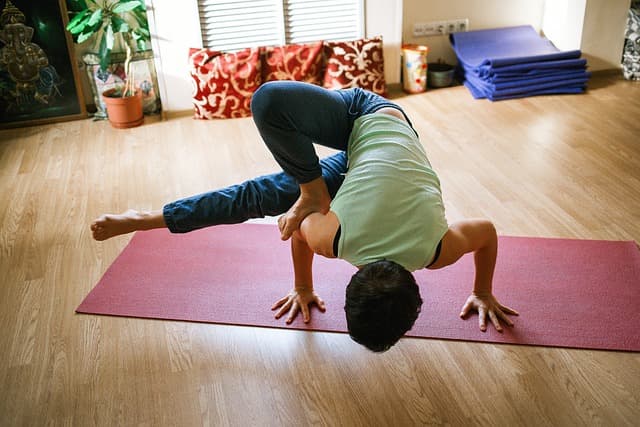
The word vinyasa literally means “connection.” And vinyasa yoga is a series of poses connected together by the energy of the inhalations and exhalations. This means that each movement flows from one to the next and is coordinated with the breath. The movements in vinyasa yoga are smooth, fluid, reminiscent of dance. That is why this direction is often called “vinyasa-flow” – from English “flow”.
The application of vinyasa in yoga practice and in everyday life is much like steering a boat. Moving through life requires synchronization with the natural forces of nature through intuition and mindfulness, as well as the ability to set your course, taking into account the wind and currents. If you want to sail a boat, you need to know how to utilize the weather conditions, which are constantly changing, as are our senses and spiritual states.
The teachings of yoga include the concept of parinamavada, the basic idea of which is that change is an integral part of life. Therefore, in order to be effective in our actions, we must understand where we are today. We cannot assume that we are the same person we were yesterday. We tend to ignore the fickle nature of our body and mind, rejecting the reality of who we are in favor of the idea of who we “should be.” This manifests itself on the yoga mat in a variety of poor choices: an intense practice when we are tired; a relaxing practice when we feel already sluggish; attending an advanced yoga class when a beginner group would be more appropriate to the experience and current state. To avoid these potentially unsafe choices, we must begin by adequately assessing our current state.
Having correctly identified all the current circumstances, we can move on to the next phase of vinyasa yoga – the accumulation of strength, the building of the potential for planned action. Strength is the ability of a sailor to keep his course in the wind, of a musician to sustain the rise and fall of a melody, of a yogi to be absorbed and deep in the practice of both asana and meditation. In the vinyasa yoga method, there are many ways to build and maintain sufficient energy for action, both on the mat and in everyday life. The main one is to start any action from the breath and coordinate movement with it. Breath is our main life force and by controlling the breath we control prana, the life energy. According to this, all opening movements in vinyasa yoga are done with inhalation and contracting movements are done with exhalation.
Each of us is better at some cycle of vinyasa. Someone is good at initiating action and lifting, but has difficulty in the final phase. Deshikachar says, “it is not enough to climb a tree, we must also be able to climb down from it”. Both in asana practice and in ordinary life, we must understand how to compose the actions one after another and how to balance them. In the vinyasa yoga method, this is known as the compensation rule, where each successive pose complements the previous one and compensates for its conditionally negative effects. The transition between asanas becomes as important as the pose itself, allowing the practitioner to get the full benefit of the pose.
It is worth understanding that vinyasa is not just a sequence of body postures, but a way to awaken and maintain awareness of consciousness. Thus, vinyasa yoga is also related to the concept of Nyasa meditative practice of the tantra yoga tradition. Nyasa allows the awakening of the inner essential energy. By focusing our absolute attention on specific points of the body, we allow the divine energy of shakti to flow freely through the entire space of our being. By bringing the techniques of vinyasa yoga into our lives, we open pathways for inner and outer transformation – step by step, breath by breath.